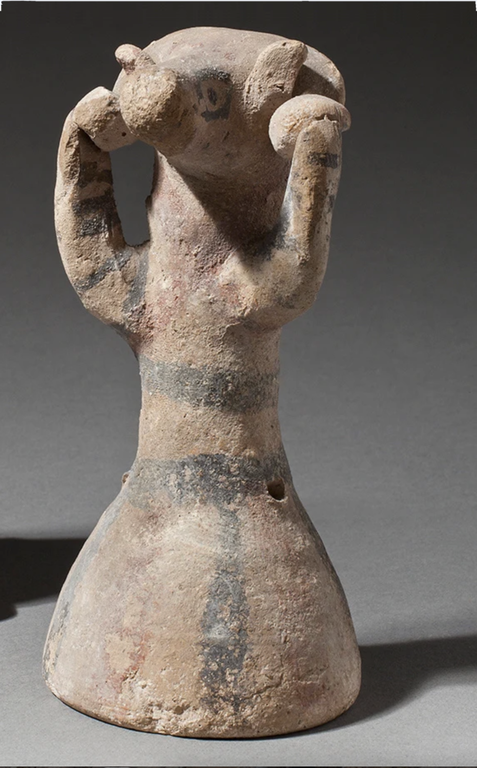
Cypriot Priest wearing ram-head mask.: Cypro-Archaic I –II (750-480 BC)
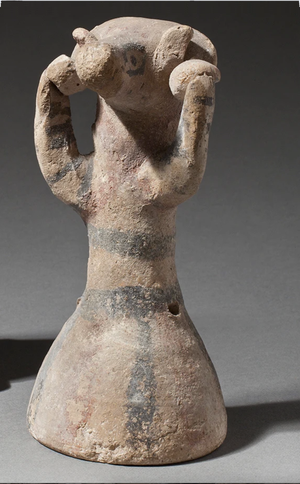
Bichrome terracotta figurine of Priest wearing a ram-head mask during a ritual, possibly a sacred dance (see previous entry.) Usually such figures wear a bull mask and one is known with a stag mask (Cesnola). The ram mask is very unusual, perhaps associated with Zeus Ammon. Here (as in no.219) the wheel-made bell shaped lower body is pierced to allow mobile legs to be attached inside, suggesting it was manipulated (one survives intact: see Karageorghis). Actual bull masks used in such rituals are known from the Late Bronze Age III, made from cut-down ox skulls, and such rituals continued for 800 years, till late in the classical period. Such figurines with bull masks are known from sanctuaries at Amathus, Kourion, Ayia Irini, Ormidhia and Peyia, and made of stone at Golgoi (and also in tombs at Amathus) and along with ram masks at Meniko and Ethianou. Votive terracotta masks are known across the island. Use of masks in rituals is still known in many cultures, though the supporting beliefs may be different. In many of the Archaic images the identity of the head as a mask is more explicit than here and sometimes the figure is taking it off or putting it on, or supporting it with his hands, as here. Occasionally imagery of disc and crescent are applied to the mask, associated with Astarte, and found also on shrine models (naskoi) (see 234).
Figure with wheel-made, hollow, cylindrical body and splayed, bell-shaped skirt pierced at top on both sides. Arms are raised to support ends of horns of ram mask, which curve out and down from near top of head, then forward and out, and slightly up. The mask has a snout and applied ears. Decorated with black and red-brown lines on pale buff: red, diagonal cross across body, front and back, and red across back of neck. Black rings around body below arms and at top of skirt. From the latter 10 lines run vertically down, alternating red and black. 5 black lines around each arm and line down back of arms. Possibly red across horns and on right ear and eyes as circles with central dot.
good condition, slight wear of snout and paint.
cf. Notes: Myers 1914 p.150, nos.129-131, p.340 no.2046, p.342 nos.2071-5; Belgiorno 1993 p. 1-27; Karageorghis 1995 p.55-57, pl.XXVII (9)-XXVIII (3); Averett 2015 p.1-27; Metropolitan Museum no. 74.51.1619
Size: H. 12.9 x W. 6.3cm
(Private collection in SW London, UK, acquired 1960s-80s. Then The Saleroom 6th Jan 2015 lot.272 (part).)
(Aquired Charles Ede, Feb 23 2026.)
(DJ 286 AN 266)
Cypriot Priest wearing ram-head mask. Cypro-Archaic I –II (750-480 BC)