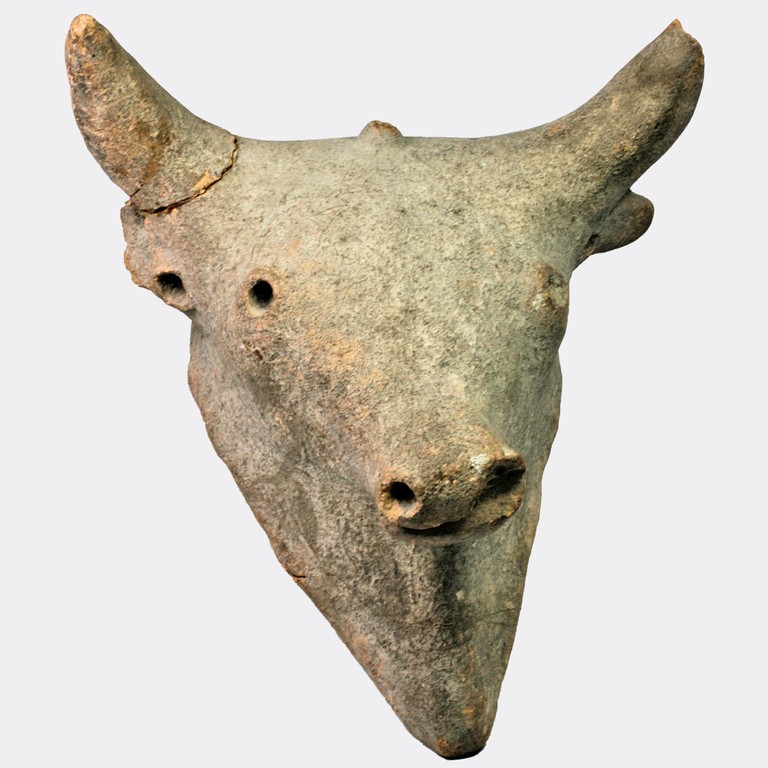
Cypriot Bull Mask Protome: Cypro-Archaic II (600-480BC)
Masks were worn by priests in rituals at sanctuaries from the Late Bronze Age (Late Cypriot IIIA), dying out nearly 800 years later in the late Cypro-Classical, after which Greek theatre masks appeared. The former almost immediately displayed the three types: anthropomorphic (bearded males), horned animals (mostly bulls) and a small number of grotesques.
In the early period till the end of Geometric II, terracotta masks are known from four sites. At the sanctuary of the Ingot God at Enkomi (and similarly Kathari- Kition), c.100 animal skulls were found, chiefly bulls, some of which had been modified for use as masks. Through the Archaic period there was an explosion of their use, with terracotta masks and figurines of priests wearing them found across the island in urban and rural sanctuaries, usually of male gods, and a few deposited in tombs (chiefly at Amathus). Possibly these rituals involved sacred dances involving the musicians depicted in large numbers of votive figurines (see 231). Although often pierced at the back for attachment, as here, most terracotta masks were too small to wear, and may be special votive offerings referencing such rituals, and perhaps hung up. Often priests are depicted taking off or putting-on the mask, depicting the threshold of taking-on the power of the divine spirits: fusing the worlds of nature and culture, magically harnessing the power and male potency of the bull for protection, and to support the elite social ideology. (Averett)
The importance of the cult of horned animals in Cyprus, sometimes involving their sacrifice, is central from the start of the Early Cypriot Bronze Age (see items 24, 86, 107, 117, 133, 151-3, 210, 223 and appendix – Vounous bowl II (bulls), 33, 35, 130 (stags), 33, 85, Vounous bowl II? (bezoar goat), 182 (ram), as well as on many coins (247-263), and cylinder seals (178). But bull-man imagery is known from much earlier across the near East and also in the Aegean (especially Crete). It has been suggested Cypriot use of such masks in the early Iron Age may have revived their use in the Levant. See also the Master of Animals cult (240).
Here all entry points of the senses, including ears are strongly pierced. Some other masks, including anthropomorphic ones, have the knob on the forehead as here.
Hollow bull mask protome, pierced through top edge for attachment, with curved horns, small roundel on the forehead, with modelled ears pierced below, pierced eye holes, snout with slit mouth and pierced nostrils, neck extending down in front with dewlap. Partial mid or late 19th century label on back “K Chypr(e)”.
Right horn and lower neck repaired, left horn tip and right ear tip missing, the other chipped, some discolouration.
Cf./Notes: Myers 1914 p.342 no.271-5; Belgiorno 1993 p.1-27; Averett 2015 p.1-27; Metropolitan Museum nos. 74.51.1803 ; 74.51.1759 ; 51.1806 ; Musee du Louvre nos. AM 1182 ; AM 3656 ; AM 1181 ; British Museum 2009,5019.61 ; Penn Museum 54-28-122.
Size: H. 13.6 x W. 13.5cm
(Private collection Paris, formerly acquired in 19th century.)
(Aquired Helios Gallery 20 February 2026)
DJ 287 AN 267
Cypriot Bull Mask Protome Cypro-Archaic II (600-480BC)